If you have been told you don’t have enough bone for dental implants, you are not alone, and it is often not the end of the conversation. At RESTŌR in F-7 Markaz, Islamabad, we regularly see patients who have been turned away elsewhere, and in many cases we can still give them a fixed set of teeth.
Why the jawbone shrinks
When teeth are lost, the bone that held them slowly resorbs. Years of wearing dentures, gum disease and some medical conditions speed this up. In the upper jaw, the sinuses can also expand into the space where bone used to be. The result is a jaw that is too thin or too short for conventional implants in the usual positions.
The traditional answer: grafting
The conventional approach is to rebuild the missing bone first with bone grafts or sinus lifts, wait for them to heal, and then place implants. This works, but it can add months to treatment, extra surgery and extra cost, and it is not suitable for everyone.
Using the bone you still have
A different approach is to anchor implants in areas where dense bone remains, even in a heavily resorbed jaw. This is sometimes called remote anchorage.
Long, angled implants
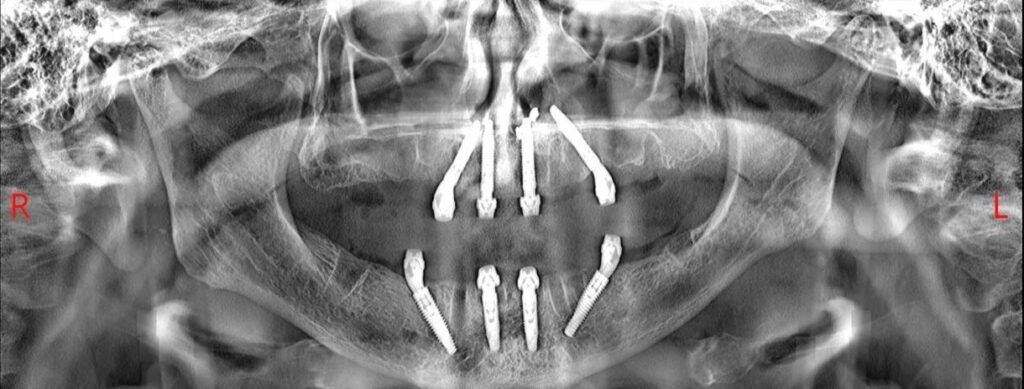
Longer implants placed at an angle can bypass the sinus or the nerve and reach solid bone. Combined with straight implants at the front, they can support a full fixed bridge. This is the principle behind All-on-4 style treatment.
Pterygoid implants
Pterygoid implants are placed at the very back of the upper jaw, where they anchor into dense bone behind the sinus. They give support at the back of the mouth without a sinus lift, which means the bridge can extend further back and you chew on more teeth.
The palatal approach
Sometimes the jaw still has height but has become too thin across its width. Rather than placing implants on the narrow crest of the ridge, they can be positioned slightly towards the palate, where more bone width remains. This palatal approach can avoid widening the ridge with bone grafts.
Implants designed for these cases
For severely resorbed jaws, we use Neodent GM long implants, which are designed to reach dense bone at an angle. The number and arrangement of implants are planned case by case on your 3D scan, using established configurations for the upper and lower jaw.
Is it right for you?
These techniques need detailed 3D (CBCT) planning and a clinician experienced in placing them. Not every patient is suitable, and we will explain honestly what is possible in your case, including the risks and alternatives.
What you can expect
- Consultation and 3D scan. We assess how much bone you have and where.
- Digital planning. Implant positions are planned around your bone and the final teeth.
- Surgery. Implants are placed, and in many cases fixed provisional teeth are fitted soon afterwards.
- Healing. The implants bond with the bone over the following months.
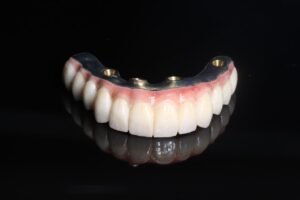
- Final bridge. A screw-retained bridge on multi-unit abutments, typically a titanium bar with zirconia, is made and fitted.
Frequently asked questions
I was told I need bone grafting first. Is there another option?
Sometimes. Angled and pterygoid implants can avoid grafting in many cases. A CBCT scan is needed to know for sure.
Will I be without teeth during treatment?
In many cases, fixed provisional teeth can be fitted shortly after surgery. We confirm this during planning.
How is the fee decided?
It depends on the number and type of implants, the abutments and the final bridge. We give you an exact fee after your consultation and scan.
Read more about full-arch implants at RESTŌR, including long, angled and pterygoid implants for jaws with little bone.
Book a consultation with Dr Omer Awan, Prosthodontist & Implantologist, at RESTŌR Dentistry & Unwind, Offices 14 & 15, 2nd Floor, Union Gold Mall, F-7 Markaz, Islamabad.